Semiconductor supply chain challenges: an essential guide

Semiconductors are under attack, and the losses no longer stop with the companies that make them. In today’s high-stakes environment, robust semiconductor logistics solutions are not simply helpful: they are critical to keeping innovation moving forward.
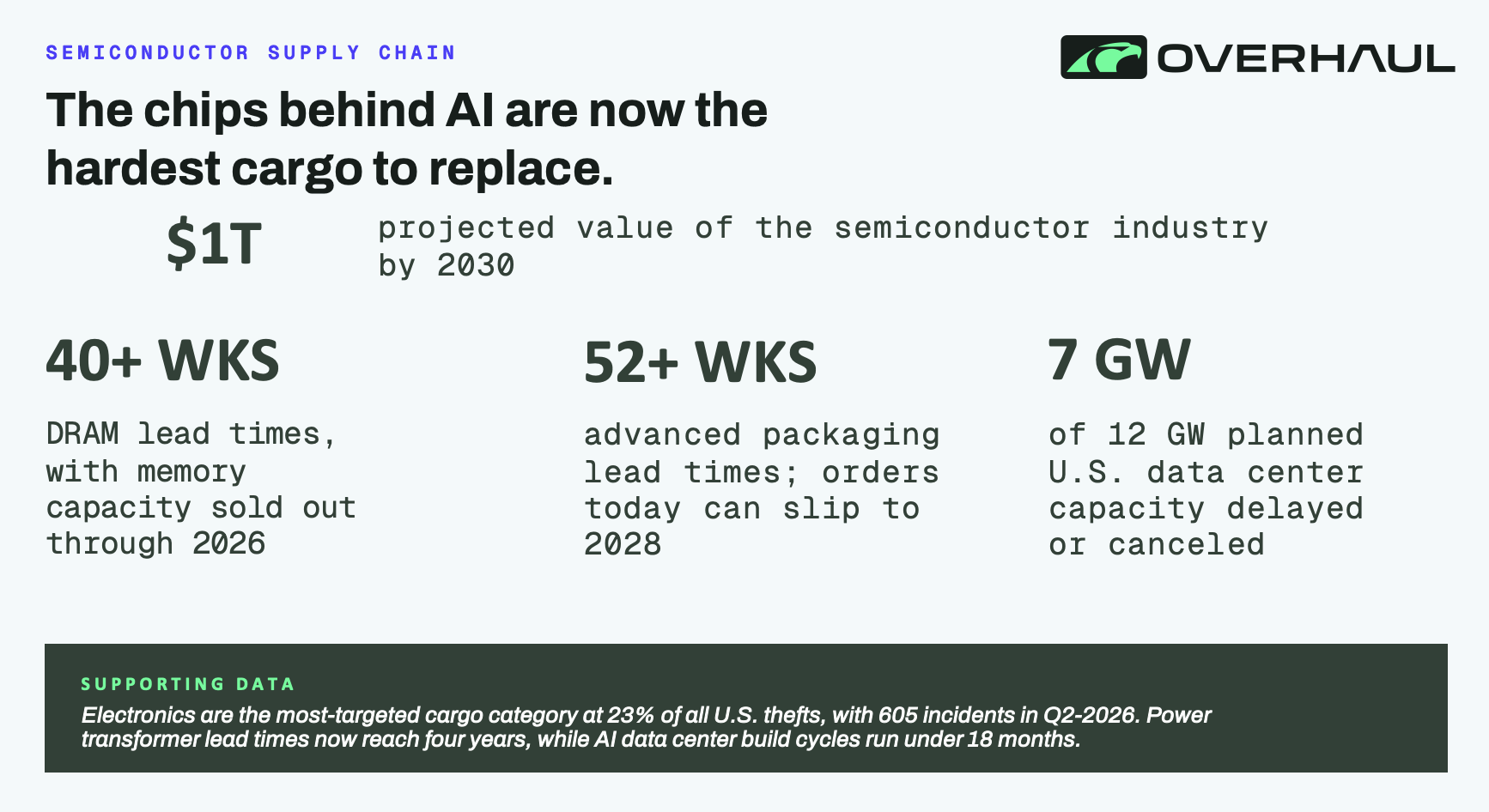
The value of the semiconductor industry is projected to reach over $1 trillion by 2030. That might sound lucrative for the industry, but it is equally appealing to cargo thieves.
The article below breaks down how the risk is evolving, who actually carries it, and which upstream controls reduce it.
Why is the semiconductor supply chain so challenging?
Since the passage of the CHIPS and Science Act in 2022, U.S. semiconductor manufacturing capacity has increased. However, global demand, particularly for advanced chips designed for artificial intelligence (AI), automotive, and medical technology, continues to far outpace supply.
The journey from manufacturing to its final destination is already risky. Now, it passes through more hands than ever. A wafer leaves a fab. It moves to an assembly and test facility, ships to a server builder, gets integrated into a rack, and finally lands in a data center.
This reality underscores how crucial upstream partners are to the health of the semiconductor supply chain. The standards and diligence applied by suppliers, contract manufacturers, and logistics providers have a direct impact on finished goods, operational continuity, and the ability to deliver products in pristine condition. By prioritizing secure handling, climate controlled transport, and transparent chain-of-custody practices, upstream partners help mitigate risk for everyone downstream, from manufacturers to hyperscalers and end users.
Supply chain disruptions
Supply chain resilience is a shared responsibility, and collaboration at every stage is essential to keeping innovation moving forward.
Any break in this supply chain causes shortages in many industries. The COVID-19 pandemic showed these weaknesses when basic chip shortages stopped production lines and led to big losses for manufacturers around the world. Today’s constraint is narrower and sharper, because the components in shortest supply are the ones with the fewest qualified sources on earth.
The supply chain is also structurally complex. Shipments cross borders, switch modes between air, ocean, and truck, and face strict timing requirements. Climate sensitivity and the risk of static discharge add further challenges.
High-consequence means high-costs
Semiconductors are not just high-value: they are also high-consequence cargo. Their real worth is what they earn once installed, not what they cost in transit, and the gap between those two numbers is now enormous.
Published 2026 rental rates put rack-scale accelerator capacity between $10.50 and $27.04 per GPU-hour. This means a single 72-GPU rack can bill about $750 to $1,900 an hour. At full use, this is $18,000 to $47,000 a day. One pallet can earn $6 million to $17 million a year, even though its purchase price is much lower.
The math scales with the site. At neocloud rates for the previous accelerator generation, a 1,024-GPU cluster left idle for six months forgoes roughly $10 million to $14 million in rental revenue. Six months of delay consumes 20% to 30% of the cluster’s capital cost before it processes a single token.
High-value high-consequence (HVHC) shipments require extra protection because a delay measured in weeks converts into revenue that is never recovered. And that loss sits with the operator rather than the shipper.
The risk does not stop at the fab
Most conversations about semiconductor risk focus on chipmakers, and that framing is too narrow. A modern AI chip is handed off at least four times before it earns revenue, and each handoff transfers the exposure downstream rather than eliminating it.
Wafer fabrication. Foundries and integrated device manufacturers produce the die. Their risk is concentrated in inbound materials, specialty gases, photoresists, and capital equipment, all of which move as HVHC cargo in their own right.
Assembly, packaging, and test. Outsourced semiconductor assembly and test (OSAT) providers and advanced packaging lines combine the die with high-bandwidth memory (HBM) and interposers into a finished accelerator. This is the step most people mean when they say "assemblers," and it is now the tightest link in the chain. A single stolen or damaged tray at this stage destroys value that cannot be replaced from inventory, because there is no inventory.
Server and rack integration. Original design manufacturers (ODMs) and electronics manufacturing services (EMS) providers build boards, populate memory, assemble sleds, and integrate full racks. These firms sit on the thinnest margins in the chain and hold the most valuable work in progress at any given moment. One of the largest server board manufacturers supplying U.S. hyperscalers has already warned that memory and processor supply gaps may dent its server shipment volumes, with component lead times pushing past 40 weeks.
Hyperscalers and enterprise operators. The final buyer carries the largest absolute loss, and it is rarely the cost of the hardware. It is the delayed energization date, the stranded power contract, the idle construction crew, the customer commitment that slips a quarter, and the capital already sunk into a shell building waiting on racks. Close to half of the U.S. data center capacity planned for this year has been delayed or canceled, roughly 7 gigawatts out of 12 gigawatts announced, with component and power equipment availability among the leading causes.
The constraint is real, and it is measured in years
Some buyers try to solve upstream shortages by placing bigger purchase orders. But long lead times show this approach does not work anymore
- Memory. The leading suppliers of high-bandwidth memory sold out their capacity through 2026 and have warned that tightness will persist into 2027 and possibly beyond, with buyers now reserving allocation years in advance. Dynamic random-access memory (DRAM) lead times have stretched past 40 weeks, and data centers are absorbing roughly 70% of global memory output.
- Advanced packaging. Assembly capacity for the highest-end accelerators is fully booked, with reported lead times of roughly 52 to 78 weeks. An order placed today can miss delivery until 2028 in some configurations.
- Fab equipment. Lead times on the tools needed to add new capacity exceed 18 months. This means the shortage cannot be engineered away inside a single planning cycle.
- Power equipment. Large power transformers now average well over two years, and U.S. lead times have extended to as long as four years for some units. AI data center deployment cycles run under 18 months, so the electrical supply chain is structurally out of phase with the compute supply chain.
- Critical materials. Export controls on gallium, germanium, and antimony have driven sharp price increases and continued disruption to chip supply chains.
When a component is on a two-year waiting list, a stolen pallet is not a replaceable loss. It is a schedule failure that propagates to every party downstream of the theft.
Theft and diversion are already happening at scale
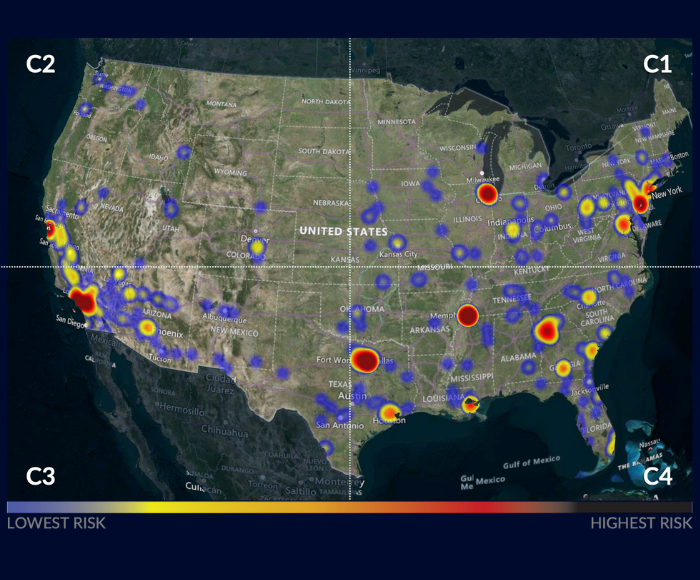
Criminal groups have industrialized cargo theft, targeting high-value shipments like semiconductors with increasingly sophisticated methods. According to Overhaul’s Q2-2026 Cargo Theft Report, cargo theft risk in the United States remains high, with 605 recorded incidents in the second quarter. This represents a 5% increase over Q1 and is among the highest levels seen in the past decade.
Electronics, including semiconductors, are the most targeted product category, comprising 23% of all thefts. This risk is especially acute in supply chain hotspots near freight hubs and large cities.
Overhaul’s field analysis underscores that semiconductor theft is a disruption that cascades downstream. Losses delay manufacturing, integration, and deployment schedules, leading to operational delays, lost revenue, and stranded investments across the entire supply chain.
Key Recommendations from Overhaul:
- Rigorous Carrier & Driver Verification: Always authenticate drivers and carriers with thorough documentation, including CDL photos, vehicle markings, license plates, and seals. Red flags should trigger immediate escalation and law enforcement engagement.
- Full Use of Tracking Technology: Deploy GPS and electronic tracking on power units, trailers, and cargo. Monitor for suspicious route deviations, unauthorized stops, and separation of cargo from the conveyance.
- Vigilance Against Deceptive Pickup: Screen all pickup activity for signs of identity theft, falsified documents, or impersonation. Document all shipment activity from origin to delivery and keep records for rapid response if theft occurs.
Overhaul’s real-time monitoring and security advice are vital for semiconductor shippers, builders, and hyperscalers. When organized groups target high-value cargo, strong logistics controls and clear upstream visibility help reduce loss and prevent disruption
Federal policy now treats upstream visibility as a requirement
On July 20, 2026, the White House issued Executive Order 14415, Securing America’s Defense Supply Chains and Ensuring Domestic Acquisition of Critical Materials. The order applies to Department of War acquisitions, and its logic transfers directly to AI infrastructure.
Within 180 days, the order directs the Secretary to require prime contractors and subcontractors at any tier to map and illuminate critical supply chains from raw materials to delivered end products. The implementing regulations must require contractors to:
- Submit a complete indentured bill of materials tracing every component, part, software element, and material back to the origin of its raw materials.
- Establish written procedures to proactively vet all suppliers and subcontractors, screening for financial distress, foreign ownership, control, or influence, and manufacturing and supply risk including capacity constraints, sole-source dependence, and over-reliance on a single source.
- Notify the government of any significant supply chain risk within 15 days of completing that vetting.
- Submit a written corrective action plan within 45 days, track mitigation actions until closure, and file a closeout report on completion.
The order also removes the comfortable middle ground. Failing to qualify a domestic source no longer counts as non-availability unless a contractor can show active, funded, ongoing qualification work, and failure to qualify an alternative source is grounds for suspending task orders or terminating a contract.
Hyperscalers and server manufacturers are not bound by this order. They are, however, exposed to precisely the risks it was written to address: single points of failure, opaque tiers, materials with one dominant global source, and suppliers whose financial or security posture nobody has verified. The federal government has now defined what adequate upstream diligence looks like. Commercial buyers can adopt the same standard without waiting to be told.
How can semiconductor logistics solutions help?
Semiconductor logistics solutions protect more than chip makers. They also help assembly and test providers, server and rack builders, and hyperscalers. These companies rely on parts that cannot be rushed with a bigger purchase order.
By combining real-time tracking, climate sensors, strict carrier vetting, and multi-tier compliance reporting, Overhaul protects product integrity and gives buyers control over risk they do not directly operate.
Learn more about Overhaul’s solutions for semiconductor companies and the broader AI hardware industry.
Frequently asked questions about semiconductor supply chain challenges
1. Why is the semiconductor supply chain so challenging and high-risk?
The semiconductor supply chain is complex, involving global sourcing, multiple handoffs, and strict timing requirements. High value, climate sensitivity, and long lead times make these shipments especially vulnerable to theft, damage, and operational disruptions.
2. What new threats are affecting domestic and global semiconductor supply chains?
Modern threats include organized cargo theft rings, fraudulent pickups, ghost carriers, and cyber-enabled schemes that impersonate legitimate logistics providers. These tactics exploit weaknesses in carrier verification and supply chain visibility.
3. How is the U.S. government responding to semiconductor supply chain risks?
Policies like Executive Order 14415 require federal contractors to map supply chains, vet suppliers, and report risks, making robust supply chain visibility and risk management a regulatory expectation for critical industries.
4. How do supply chain disruptions affect the semiconductor manufacturing process?
Supply chain disruptions, such as delays in raw materials, theft, or export controls, can stall the semiconductor manufacturing process. This can lead to missed deadlines, higher costs, and cascading shortages that impact industries dependent on integrated circuits.
5. How does Overhaul help semiconductor companies manage supply chain risks?
Overhaul’s logistics solutions deliver real-time tracking, climate and shock sensors, strict carrier verification, and multi-tier compliance reporting. They enable semiconductor companies to strengthen supply chain resilience and secure high-value shipments throughout the global supply chain.